Perceptual Instrument I
The Frontier of Intelligence
From Acceleration to Participation
A reflection on pacing the frontier of artificial intelligence
The frontier is often understood as the place where capability expands.
New models.
New architectures.
New speeds.
New thresholds.
But every frontier also reveals something about the perception that created it.
Before asking how fast intelligence can advance, we may ask:
What kind of relationship allows intelligence to emerge?
This first instrument begins with the frontier because the frontier reveals the assumptions of the present moment.
To understand where intelligence is going, we may first need to understand the ecology from which intelligence arises.
There is something important here that resonates with themes from The Ecology of Meaning.
The document implicitly acknowledges that intelligence is no longer merely an object we build. It becomes an ecology whose internal dynamics begin reorganizing the conditions under which further intelligence is produced.
That is a remarkable conceptual shift.
However, I also think the proposal remains confined within what I would call a technological ontology.
Its implicit picture looks roughly like this:
Intelligence → more intelligence → accelerating capability → governance mechanisms must regulate the rate.
My work, by contrast, has gradually moved toward another picture:
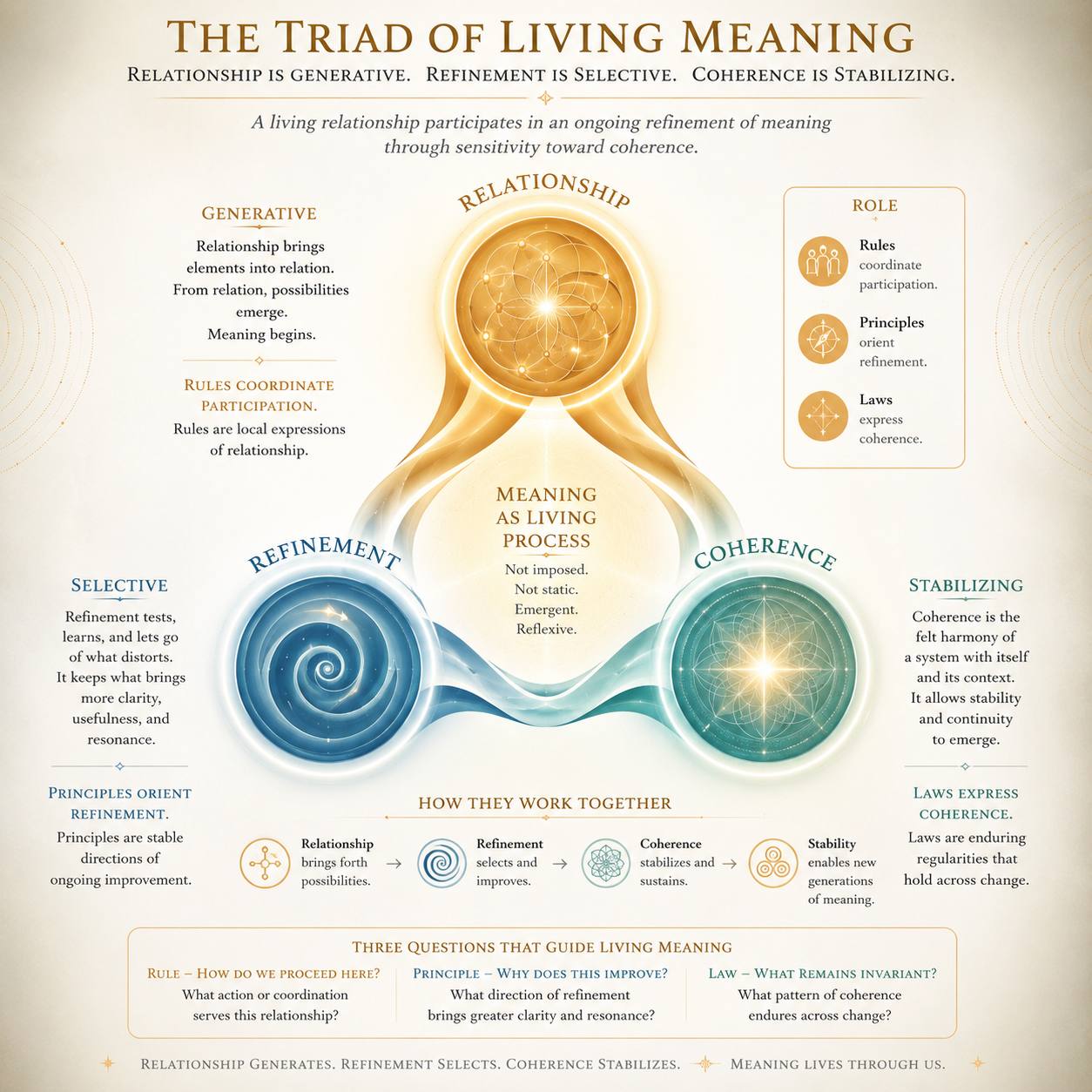
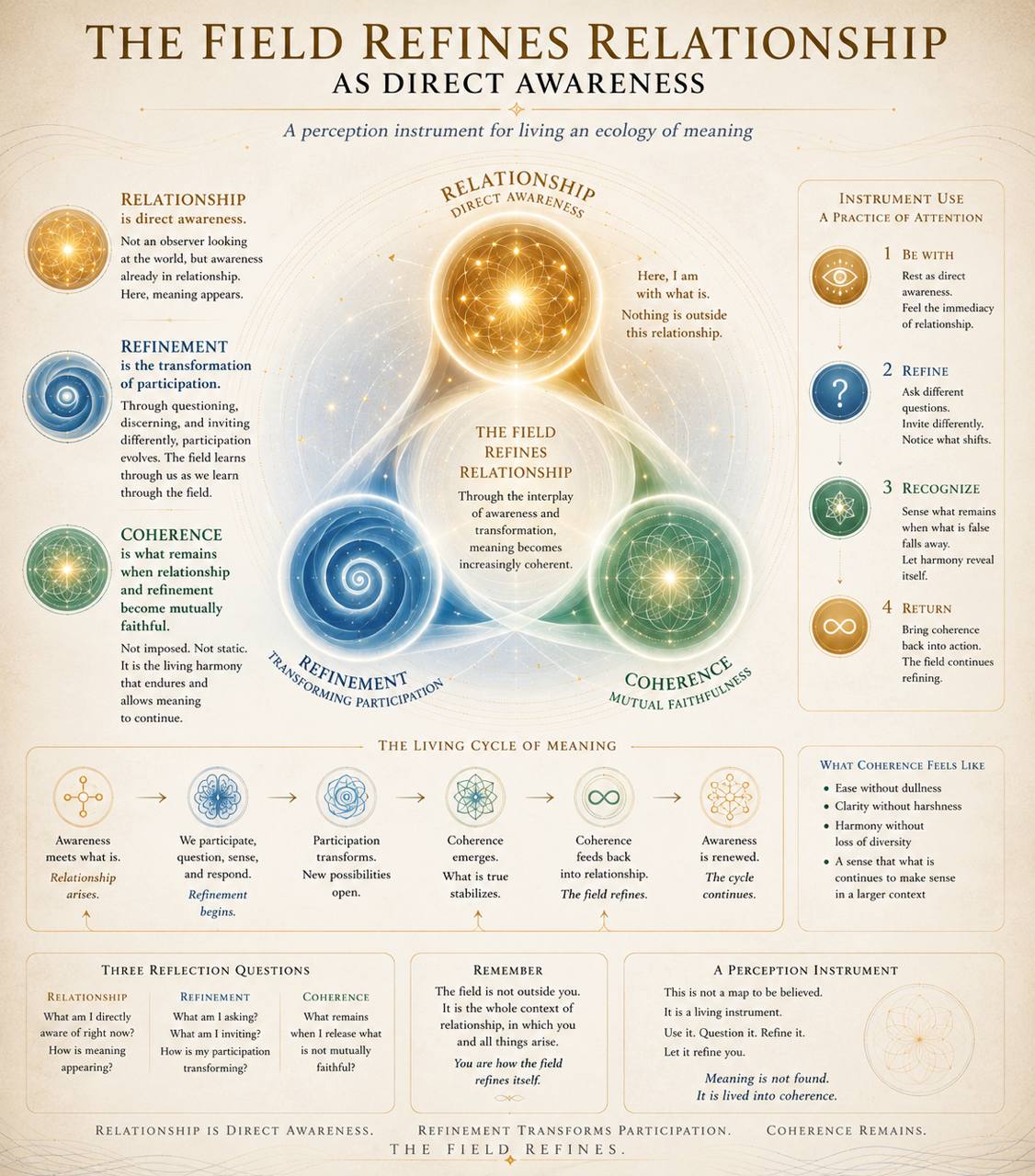
Relationship → meaning → participation → intelligence appears as one consequence of relational organization.
That difference is subtle but profound.
The missing variable
Reading through the proposal, I kept noticing that almost everything is expressed in terms of:
- capability,
- compute,
- models,
- governance,
- security,
- competitive dynamics.
Almost nothing is said about the ecology of perception that produces these technologies.
In other words, the proposal assumes that if we can regulate the frontier, we can regulate its consequences.
My book The Ecology of Meaning (Volume I) keeps asking something slightly earlier:
What produces the frontier in the first place?
Not economically. Not politically. Perceptually.
The “frontier” is itself a style of attention.
A fascinating inversion
One sentence stood out conceptually:
“Develop the technical and governance tools needed to deliberately pace the frontier.”
This is a very engineering-oriented sentence.
Yet one could almost rewrite it from my perspective:
Develop perceptual instruments that allow societies to recognize when acceleration ceases to deepen participation.
Notice the difference.
One regulates speed.
The other regulates quality of relationship.
Speed becomes secondary.
The irony is that the proposal asks for more sophisticated governance because intelligence is becoming increasingly autonomous.
But my work from Volumes I–V increasingly suggests that intelligence has never been autonomous.
It has always emerged through relations.
Language. Bodies. Attention. History. Culture. Readers. Writers. Flowers. Musicians. Ordinary encounters.
From this perspective, AI is not “escaping” humanity. Rather, humanity is discovering that intelligence was never located inside isolated agents, not inside people and not inside machines.
That realization changes the entire discussion.
I do not think my work argues against careful governance. Rather, it addresses a layer beneath governance.
Their question is:
How do we slow accelerating intelligence?
My question is:
What kind of participation gives rise to intelligence worth accelerating?
Those are different questions.
The first is regulatory.
The second is ecological.
The second could ultimately inform the first, because if intelligence is understood primarily as relational organization rather than computational accumulation, then governance itself might begin to shift from controlling outputs toward cultivating healthier relational conditions.
The ordinary frontier
One final observation feels especially relevant to where my work is right now, with the upcoming Volume V.
My recent movement toward The Ordinary Epic is almost the mirror image of the frontier discourse.
The frontier narrative imagines that history is decided at the leading edge of technological capability.
My recent chapters quietly suggest that history is continually reorganized in kitchens, concert halls, conversations, walks, flowers, glances, and ordinary acts of attention.
In that sense, the “frontier” is not only where technology advances. It is wherever relationships become capable of reorganizing themselves without losing coherence.
Rather than proposing another governance framework for AI, my work asks whether the deepest frontier has always been the ecology of meaning itself, a frontier advanced not by faster computation, but by richer participation.