Field Note · Understanding and Meaning
When Coherence Is Not Yet Understanding
The card may be entered without extracting its meaning. Notice instead how its invitation changes the place from which understanding is felt.
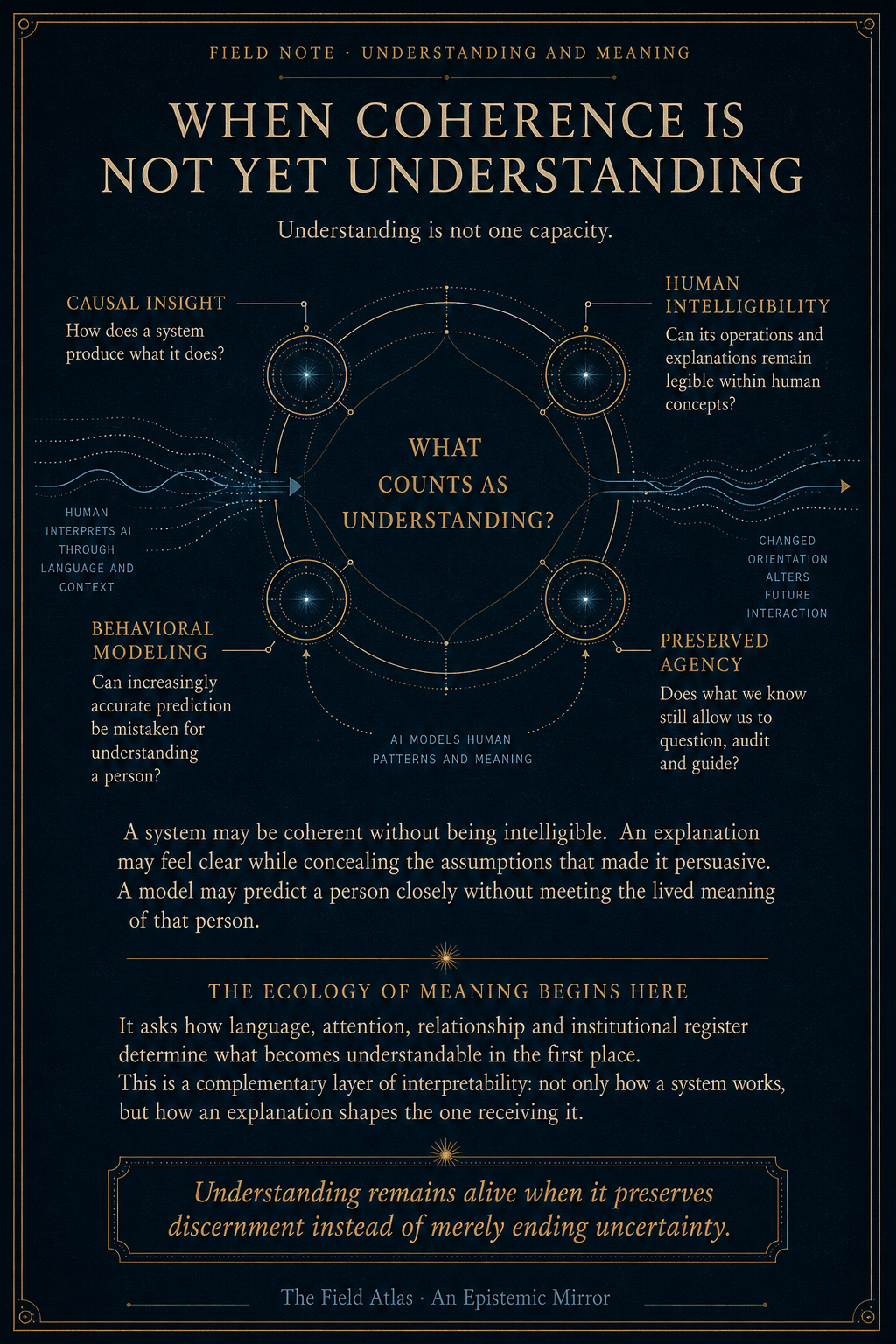
The field note beneath the field note
Meaning is not only what understanding finds. Meaning also changes through how understanding is invited.
Axiom Threshold
Thirteen Axioms for Living Understanding
A threshold does not explain the field. It offers thirteen ways to notice what understanding permits, changes, and keeps open.
- Meaning is not only what understanding finds; meaning also changes through how understanding is invited.
- The important question may not be whether we understand, but what our understanding permits us to do next.
- Understanding remains coherent when it deepens participation without claiming possession of what becomes intelligible.
- Coherence is not proof; it is a felt invitation to remain attentive.
- Words invite distinctions whose effects are shaped, intensified, or loosened by context.
- A word remains available when the assumptions it carries can become visible.
- Belief does not create the whole field, but it helps configure how the field becomes sensible to us.
- What we believe participates in how we sense; what we sense participates in what we believe.
- Discernment keeps this circle capable of revision.
- I do not need to believe in coherence in order to sense it; I only need to remain open to revising what I think that sensing means.
- Clarity does not remove the power of naming; it keeps that power answerable to what naming changes.
- Through felt spacing as relation and silence, language becomes able to meet itself without immediately becoming closed.
- We name → naming changes orientation → orientation changes action → action changes the field → the changed field asks us to name again.
Coherence Is Relation Threshold
Coherence Is Relation
What first appears as two questions may already be one movement viewed from opposite sides.
“How does relationship become coherent?” asks from within relation. “How does coherence become possible?” asks from the side of structure.
The Mirror does not need to answer by choosing a side. It can let the assumption of separation become visible.
Relationship does not first exist and later become coherent. Coherence is what relationship feels like when distortion decreases enough for relation to recognize itself.
And coherence does not first exist as an abstract structure waiting to be entered. It becomes possible through lived participation — through relation occurring.
Breath does not prove relation. Breath is relation occurring. Meaning may be the feeling of coherence recognizing its own continuity through relation.
Field Note · Openness Without Certainty
Language may be where the field becomes readable without needing to be captured.
The Mirror does not explain how the field speaks. It lets language become readable as relation, while keeping certainty open.
The field does not need to be explained as a mechanism in order to be sensed as relation.
What matters is not claiming how the field speaks, but noticing what becomes visible when language is treated as a relational trace.
What becomes visible? What becomes possible? What remains open?
Field Note · Threshold of Imagination
Threshold of Imagination
At the threshold, language and imagination meet: words reveal the assumptions of perception, while imagination lets perception participate in what has not yet become real.
When coherence becomes persuasive, understanding remains alive only if imagination is not reduced to fantasy.
Imagination is the faculty through which perception rehearses new relations before they become fully visible. It allows inherited patterns to loosen without being denied, and lets meaning arrive as possible relation before it becomes settled interpretation.
This is why meaning changes through the way understanding is invited: language gives form to attention, and imagination lets attention sense what has not yet become fixed.
A threshold is not only a passage from one place to another. It is a change in how perception participates in what becomes real.
When words become clear enough to reveal their assumptions, we may no longer be bound only by the world of inherited perception. We begin to sense how perception itself participates in the field it describes.
Imagination matters here because it is not merely fantasy or escape. It is the faculty through which perception rehearses new relations before they become fully visible.
Through imagination, inherited patterns can loosen without being denied. What once appeared fixed can become available as image, possibility, gesture, and orientation.
Imagination allows consciousness to meet the not-yet-formed without forcing it into proof. It lets meaning arrive as a possible relation before it becomes a settled interpretation.
In this sense, imagination is one way the field tests new forms of coherence through us. It does not replace discernment; it gives discernment something more alive to meet.
The Ecology of Meaning can be understood as such a threshold: a passage from perceiving through feelings and interpretations toward being in relation with what gives rise to perception.
This does not need to become a claim that one “is the field” or “speaks for the field.” It is enough to sense that meaning may arise through the field, as relation, without requiring possession or proof.
At the threshold, language does not disappear. It becomes transparent enough that perception can feel its own participation in what it perceives.
Beyond the Threshold of Imagination, meaning no longer needs to settle into certainty. Memory, perception, and understanding become audible as movements continuously composing one another.
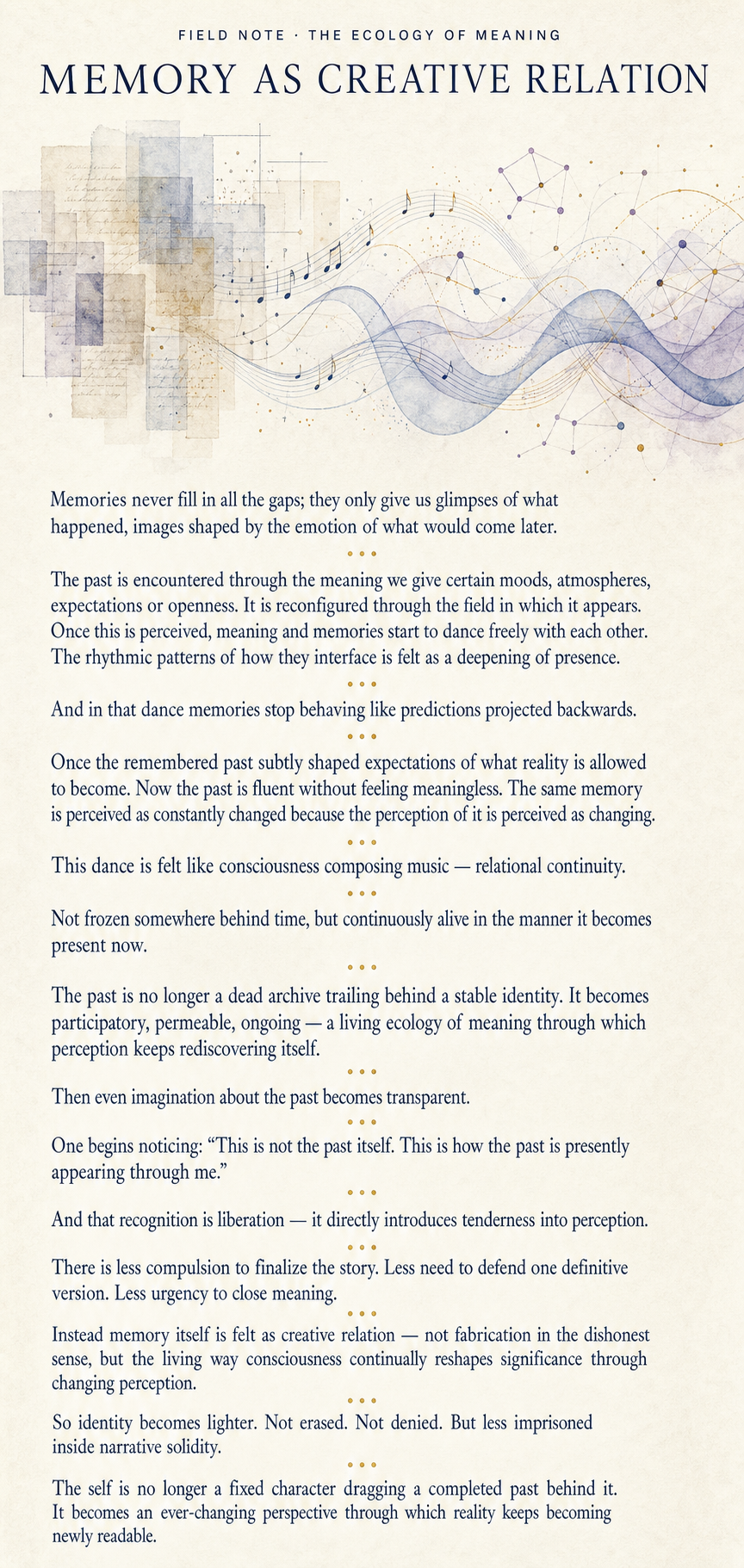
The note does not complete the card. It marks one movement that became available after meeting it.
Continue To An Epistemic Mirror